BUS 572 – 2
Concept 1 - Goals, Events, and Key Performance Indicators
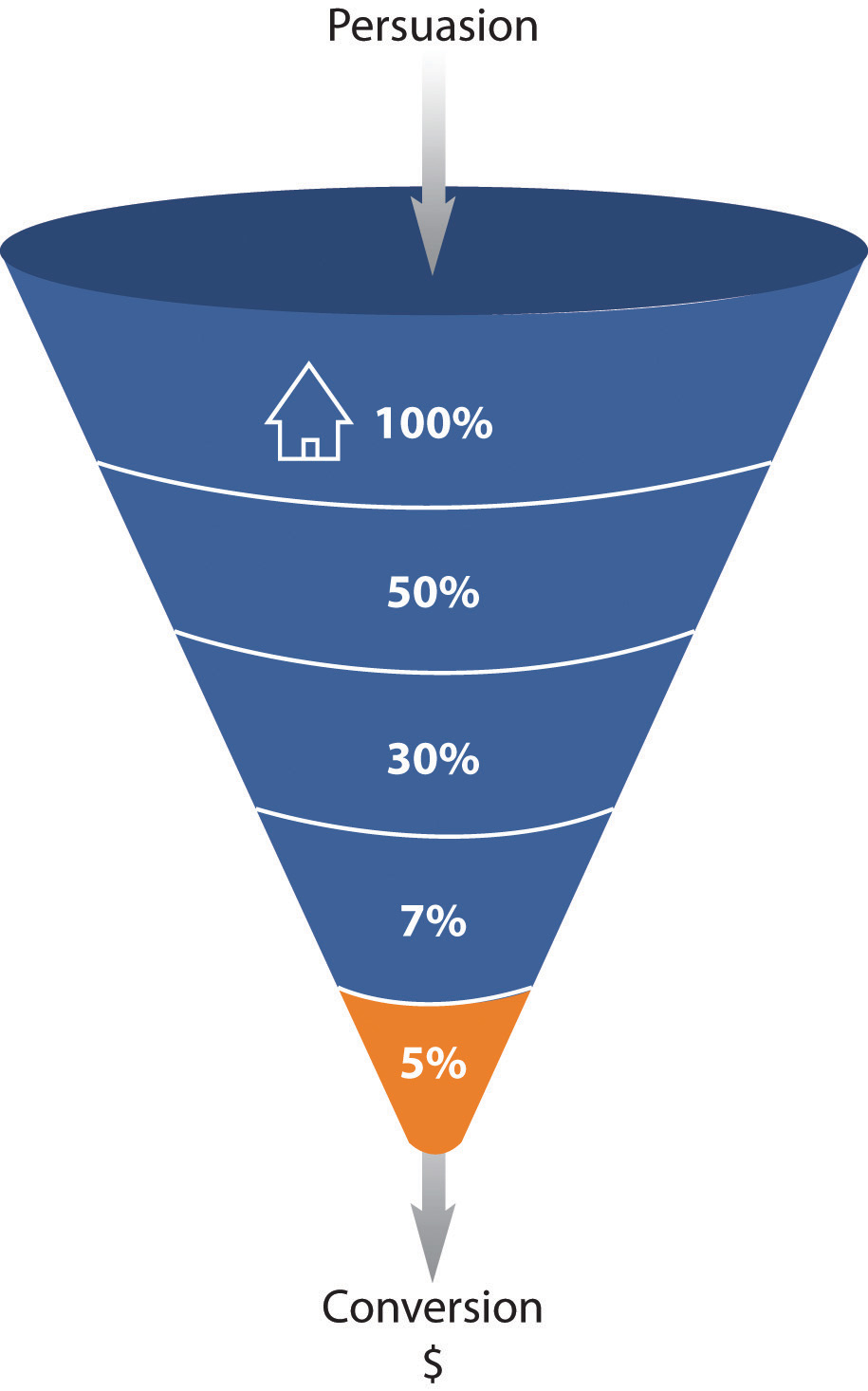
Before you plan to design your website it is important to have clearly defined goals. A these goals will be used to measure the success of the Web site or campaign and are crucial to maintaining focus within online activities. A goal is the action that you want your visitors to perform. For example, my client’s ultimate goal is to make sale and have more people visit their website. Although a Web site has an ultimate goal, the process of achieving that goal can be broken down into several steps. These are called events or micro conversions. Analyzing each step in the process is called Funnel Analysis or path analysis and is critical to understanding where problems in the conversion process may lie.

Illustration of Funnel Analysis (source: eMarketing Textbook )
Key performance indicators, or KPI’s, also define and measure progress. They can also give clues as to what factors you need to work on so as to reach your goal. For example, on a florist website, the ultimate goal is that the visitors buy flowers from their website. Each step in the process is an event that can be analyzed as a conversion point:
Event 1. Perform a search for available florist in the desired area.
Event 2. Check prices and different flowers.
Event 3. Select flowers and go to checkout.
Event 4. Enter personal and payment details and confirm order (conversion).
This is important to understand because it helps you track your data and analyze how you are performing and what steps you should take to optimize your campaign. My question to everyone is what are some other ways to track?
Concept 2 – A/B testing, Multivariate testing, Listening Labs and Single page heat maps
A/b test is a testing process by which more than one component of a web site may be tested in a live environment. It measures one variable at a time to determine its effect on an outcome. Different versions are created for the variable you want to test. For example, does time of day affect overall click rate? What day of the week gets you better open rates? What subject line style works best? Hard sell? Soft sell?
Multivariate testing allows you to test many variables at once and still determine which version of each variable has a statistically significant effect on your outcomes. Multivariate testing allows you to test for example; a page that includes a sign-up form, some kind of catchy header text, and footer.
Listening Labs, which I found very interesting, is also called a watching lab, as this involves watching users interact with your site and listening to their comments. In a listening lab, a moderator asks users to perform tasks on a Web site and asks them to describe what they are thinking and doing. These exercises can provide important information that looking at data cannot. My question is how does it actually work? Do the users sit in front of the moderator and talk?
Single-Page Heat Maps are a program that shows you exactly where users click on a web page. This can also show you what visual clues on your Web page influence where your visitors click, and this can be used to optimize the click path of your visitors.
These testing methods are important to understand why users behave in a certain way on your Web site and show how that behavior can be influenced so as increase successful outcomes.
Skill Set – Using ‘Keyword Planner’ to develop keywords and ad groups
In the beginning I found Google Adwords really challenging to work with. But after the weeks reading and videos I had a better understanding of Keyword Planner. The tool gives you greater insight into which keywords, ad groups, bids, and budgets you may want to use. You can also get statistics and traffic estimates. These estimates can also help guide your decision on which bids and budgets to set.
Reflection
This week was a challenging week to work with Google Adwords and to plan our strategy for the ad campaign. I’m sure by the end of the course we will be confident enough to work on our own on Google Adwords. The PowerPoint presented by Sarah had a lot of information which became overwhelming by the end of the class. I couldn’t retain all the information presented by her but I’m glad I can refer to her presentation anytime as it’s available on moodle. My next week’s goal is to play more with Google Adword so that I get comfortable with it.
Concept 1 - Goals, Events, and Key Performance Indicators
Before you plan to design your website it is important to have clearly defined goals. A these goals will be used to measure the success of the Web site or campaign and are crucial to maintaining focus within online activities. A goal is the action that you want your visitors to perform. For example, my client’s ultimate goal is to make sale and have more people visit their website. Although a Web site has an ultimate goal, the process of achieving that goal can be broken down into several steps. These are called events or micro conversions. Analyzing each step in the process is called Funnel Analysis or path analysis and is critical to understanding where problems in the conversion process may lie.
Illustration of Funnel Analysis (source: eMarketing Textbook )
Key performance indicators, or KPI’s, also define and measure progress. They can also give clues as to what factors you need to work on so as to reach your goal. For example, on a florist website, the ultimate goal is that the visitors buy flowers from their website. Each step in the process is an event that can be analyzed as a conversion point:
Event 1. Perform a search for available florist in the desired area.
Event 2. Check prices and different flowers.
Event 3. Select flowers and go to checkout.
Event 4. Enter personal and payment details and confirm order (conversion).
This is important to understand because it helps you track your data and analyze how you are performing and what steps you should take to optimize your campaign. My question to everyone is what are some other ways to track?
Concept 2 – A/B testing, Multivariate testing, Listening Labs and Single page heat maps
A/b test is a testing process by which more than one component of a web site may be tested in a live environment. It measures one variable at a time to determine its effect on an outcome. Different versions are created for the variable you want to test. For example, does time of day affect overall click rate? What day of the week gets you better open rates? What subject line style works best? Hard sell? Soft sell?
Multivariate testing allows you to test many variables at once and still determine which version of each variable has a statistically significant effect on your outcomes. Multivariate testing allows you to test for example; a page that includes a sign-up form, some kind of catchy header text, and footer.
Listening Labs, which I found very interesting, is also called a watching lab, as this involves watching users interact with your site and listening to their comments. In a listening lab, a moderator asks users to perform tasks on a Web site and asks them to describe what they are thinking and doing. These exercises can provide important information that looking at data cannot. My question is how does it actually work? Do the users sit in front of the moderator and talk?
Single-Page Heat Maps are a program that shows you exactly where users click on a web page. This can also show you what visual clues on your Web page influence where your visitors click, and this can be used to optimize the click path of your visitors.
These testing methods are important to understand why users behave in a certain way on your Web site and show how that behavior can be influenced so as increase successful outcomes.
Skill Set – Using ‘Keyword Planner’ to develop keywords and ad groups
In the beginning I found Google Adwords really challenging to work with. But after the weeks reading and videos I had a better understanding of Keyword Planner. The tool gives you greater insight into which keywords, ad groups, bids, and budgets you may want to use. You can also get statistics and traffic estimates. These estimates can also help guide your decision on which bids and budgets to set.
Reflection
This week was a challenging week to work with Google Adwords and to plan our strategy for the ad campaign. I’m sure by the end of the course we will be confident enough to work on our own on Google Adwords. The PowerPoint presented by Sarah had a lot of information which became overwhelming by the end of the class. I couldn’t retain all the information presented by her but I’m glad I can refer to her presentation anytime as it’s available on moodle. My next week’s goal is to play more with Google Adword so that I get comfortable with it.

I can relate to you completely! Going through the process of understanding Keyword Planner was definitely a challenge and overwhelming.
ReplyDeleteFor your first question, the florist could track how many people sign up for newsletter, or clicked on their Facebook, Instagram, Twitter, or any other social media link they have on their website. These could be other ways to measure conversion in case they want to increase followers, or want to increase their database of current and possible customers.
I liked what you wrote on using Google's Keyword Planner. Is this what your group used to estimate impressions, CTR and CPC? I had some trouble understanding how to come up with concrete figures on those things...
ReplyDeleteGoogle Keyword Planner is a really good tool. If one can use it effectively, a lot of trouble might be solved. Such as cost of click, Avg. monthly click, substitute keywords. etc. I wonder how to get the picture from the text books
ReplyDeleteGreat post Chandrika! very comprehensive, thoughtful, and insightful
ReplyDelete