Tuesday, March 25, 2014

BUS572- 5 Google Analytics Courses and Reflection


First of all, I would say it took me 7 hours at a stretch to complete these courses. They provided a lot of information on how Google Analytics work and the best part was to be able to practice on a ‘test account’ to get the real idea. I found the Behavior Flow reports most useful part of using Google Analytics. They visualize the path visitors traveled from one Page or Event to the next. This report can help in discovering what content keeps visitors engaged with your site. Unfortunately we will not be able to apply this for our client’s account as she doesn't have Google Analytics code setup on her website. But, I’m sure this would look good on my resume.  

Tuesday, March 4, 2014

Blog 572 - 4 

Concept 1 – Google Display Network (GDN Reserve) 

The first concept from this week that I would like to mention is GDN Reserve. Google Display Network Reserve means advertisers can guarantee impressions across brand-safe sites on the Google Display Network. It is a form of placement targeting that gives you: guaranteed impressions, at a fixed CPM price, and against pre-screened brand-safe inventory. GDN Reserve offers three main benefits:
  • Not Auction – Based - Reserve offers you space on the GDN without having to concern yourself with the vagueness in pricing inherent in an auction/real time biding model.
  • AugmentationGuaranteed impressions on relevant content during product launches or YouTube homepage buys to extend the effectiveness of the campaign.
  • GuaranteeSpend and volume is guaranteed, so fixed budgets, leftover budgets, and limited time offers are acted against quickly and effectively. 

GDN Reserve offers eleven categories; entertainment channel, sports channel, news channel, tech channel, women’s interest channel, men’s PG channel, local channel, education channel, B2B channel, Hispanic channel, health channel and custom channel. For example, you are trying to promote a tennis ball; in GDN Reserve you would select sports channel sites as your category to show your advertisement. Google Display Network Reserve works well if you want to achieve significant awareness of your brand in a set time period. Because it offers guaranteed ad impressions at scale, and only places ads on brand-safe websites, advertisers often use Google Display Network Reserve when they're launching new products, promoting a limited time offer, or running a holiday or event-specific promotion.

Illustration of 11 categories (Source: GOMC Digital Marketing Course)
      
Concept 2 – Topic targeting

Topic targeting allows ads to be eligible to appear on any pages on the Google Display Network that have content related to your selected topics. Just like your business caters to certain customers, your customers may be interested in certain topics. Topic targeting lets you place your AdWords ads on website pages about those topics, whether it's agriculture, music, or something else entirely. You can use topic targeting in combination with individual placements -- which are pages or sites you've chosen where you'd like your ad to show and keyword targeting which lets you choose the keywords that should trigger your ad to show. For example, by targeting the "Women accessories" topic, for instance, you enable your ad to appear on any Google Display Network website or other placement that includes content about handbags, jewelry, scarfs etc. You can also select more precise subtopics, such as pendants, pearls, purses or clutches. This can be extremely helpful because there are many potential customers out there that are interested in a variety of different automobiles. 

Isn’t Topic Targeting quite similar to GDN Reserve? Both have categories?


                         Illustration of topics (Source: GOMC Digital Marketing Course)

Skill Set

As we have a team presentation this week on display advertising I have learned a lot about GDN Reserve. According to my understanding, this is the safest way to advertise on Google AdWords. It is a guaranteed way of getting impression across brand-safe sites on the Google Display Network. Furthermore, you get to place your ads in most relevant categories. For example, if I’m trying to sell women’s shoes, I would place my ad in “women’s interest categories” to get most impressions.  

Reflection

This week’s reading was the most confusing to me. There was so much to read and it was very complex, especially the article “An Empirical Analysis of Search Engine Advertising: Sponsored Search in Electronic Markets” by Ghose and Yang 2009, was extremely hard and I didn’t understand anything and in the end lost interest in it. I’m not sure how I’m going to perform on this week’s quiz. Other than that, I’m looking forward to registering for the campaign and get our ad running on search engine. For next week, I hope to learn more about tweaking our ad according to the feedback generated from click through rates.      

Wednesday, February 19, 2014

BUS 572 - 3


Concept 1 - Search engine optimization (SEO)


Illustration of SEO (Source: SEO)

The process of making a site "search engine-friendly" - also known as "SEO" -- is probably the most important aspect of website design. Search engine optimization (SEO) is the process of affecting the visibility of a website or a web page in a search engine's ‘natural’ or un-paid (‘organic’) search results. In general, the earlier (or higher ranked on the search results page), and more frequently a site appears in the search results list, the more visitors it will receive from the search engine's users. It needs to help users find what they’re looking for. To make sure they list the best results first, they look for signals of the following:
Relevance - for instance, every title, sentence, phrase, header, link, filename, graphic name, video name, data element name, you put into your web page, make sure it is somehow relevant to your subject.
Importance – how important is the content of the website for search result?
Popularity – how many times the website has been viewed?
Trust – is the website/link trust worthy?
Authority - Is your site an authority? Is it a widely recognized leader in its field, area, business or in some other way?

Concept 2 – Link Popularity 

Illustration of SEO Link Building (Source:  Link Building)

The purpose of a link is to allow a user to go from one Web page to another. Generally, the more votes a Web site receive, the more trusted it becomes, the more important it is deemed, and the better it will rank on search engines. Through links, search engines can not only analyze the popularity of a website & page based on the number and popularity of pages linking to them, but also metrics like trust, spam, and authority. Trustworthy sites tend to link to other trusted sites, while spam sites receive very few links from trusted sources. In our group project we realized that our client’s website doesn't have many external links, which means very few external sites were linking to our client’s website. Having a high link popularity is an excellent way not only to build a website but to also show others how good the website it. When other web pages link to a particular website it draws additional traffic for that website, as well as giving it what constitutes as votes in the search engine rankings. When two websites with very close levels of search engine optimization and information are being ranked by a search engine, more often the search engine will choose to rank the particular website with the higher link popularity first on search engine results pages.
 My question is how can we build the link popularity for our client’s website? Her present external links are Facebook and Twitter only.

Skill Set – Keywords


The most important concept we learned is developing list of potential keywords. Ranking for the "right" keywords can make or break your website. Using keywords correctly throughout a page and a website can be critical when you are trying to improve search engine ranking as part of your Internet marketing strategy.  Because of this, it is crucial that Web sites contain content with keywords that are likely to be used by their target audience. Web sites need to appear when their potential customers are searching for them. For our project we would recommend our client to add more relevant text in her website and using the right keywords.

Reflection

This week’s reading didn’t involve too much new content, but a more detailed version of what we have previously learned. We have already studied about SEO and keyword research in the past weeks so this was like a revision. For the next week I hope to learn more about the campaigns and maybe see some examples or more information about how the competition works. I am also looking forward to this week’s class presentations as well as get ready for our group to present in the following week.

Wednesday, February 5, 2014

BUS 572 – 2

Concept 1 - Goals, Events, and Key Performance Indicators


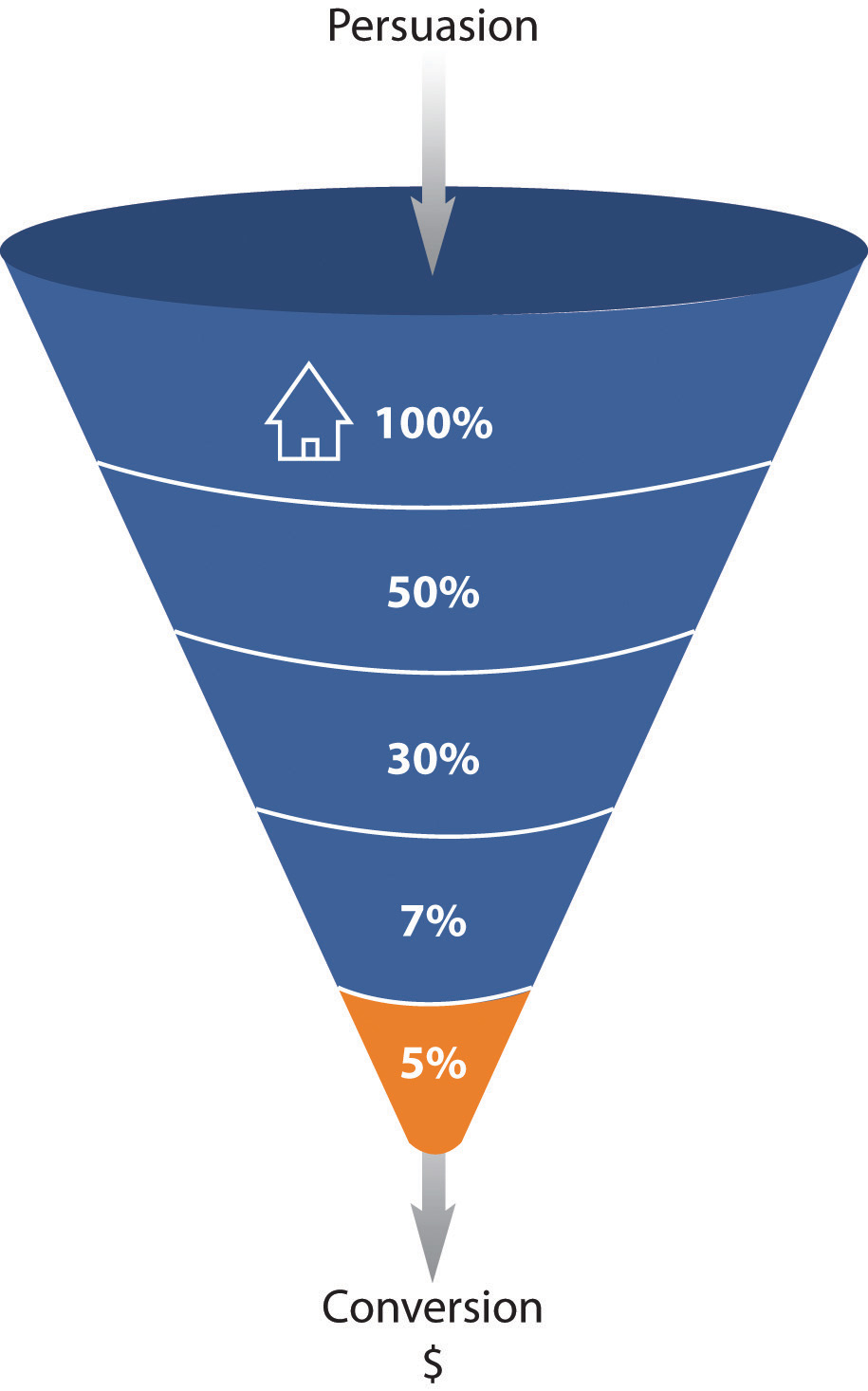
Before you plan to design your website it is important to have clearly defined goals. A these goals will be used to measure the success of the Web site or campaign and are crucial to maintaining focus within online activities. A goal is the action that you want your visitors to perform. For example, my client’s ultimate goal is to make sale and have more people visit their website. Although a Web site has an ultimate goal, the process of achieving that goal can be broken down into several steps. These are called events or micro conversions. Analyzing each step in the process is called Funnel Analysis or path analysis and is critical to understanding where problems in the conversion process may lie.


                      Illustration of Funnel Analysis (source: eMarketing Textbook )        

Key performance indicators, or KPI’s, also define and measure progress. They can also give clues as to what factors you need to work on so as to reach your goal. For example, on a florist website, the ultimate goal is that the visitors buy flowers from their website. Each step in the process is an event that can be analyzed as a conversion point:

Event 1. Perform a search for available florist in the desired area.
Event 2. Check prices and different flowers.
Event 3. Select flowers and go to checkout.
Event 4. Enter personal and payment details and confirm order (conversion).
This is important to understand because it helps you track your data and analyze how you are performing and what steps you should take to optimize your campaign. My question to everyone is what are some other ways to track?

Concept 2 – A/B testing, Multivariate testing, Listening Labs and Single page heat maps

A/b test is a testing process by which more than one component of a web site may be tested in a live environment. It measures one variable at a time to determine its effect on an outcome. Different versions are created for the variable you want to test. For example, does time of day affect overall click rate? What day of the week gets you better open rates? What subject line style works best? Hard sell? Soft sell?


Multivariate testing allows you to test many variables at once and still determine which version of each variable has a statistically significant effect on your outcomes. Multivariate testing allows you to test for example; a page that includes a sign-up form, some kind of catchy header text, and footer.

Listening Labs, which I found very interesting, is also called a watching lab, as this involves watching users interact with your site and listening to their comments. In a listening lab, a moderator asks users to perform tasks on a Web site and asks them to describe what they are thinking and doing. These exercises can provide important information that looking at data cannot. My question is how does it actually work? Do the users sit in front of the moderator and talk?

Single-Page Heat Maps are a program that shows you exactly where users click on a web page. This can also show you what visual clues on your Web page influence where your visitors click, and this can be used to optimize the click path of your visitors.

These testing methods are important to understand why users behave in a certain way on your Web site and show how that behavior can be influenced so as increase successful outcomes.

Skill Set – Using ‘Keyword Planner’ to develop keywords and ad groups

In the beginning I found Google Adwords really challenging to work with. But after the weeks reading and videos I had a better understanding of Keyword Planner. The tool gives you greater insight into which keywords, ad groups, bids, and budgets you may want to use. You can also get statistics and traffic estimates. These estimates can also help guide your decision on which bids and budgets to set.  

Reflection  

This week was a challenging week to work with Google Adwords and to plan our strategy for the ad campaign. I’m sure by the end of the course we will be confident enough to work on our own on Google Adwords. The PowerPoint presented by Sarah had a lot of information which became overwhelming by the end of the class. I couldn’t retain all the information presented by her but I’m glad I can refer to her presentation anytime as it’s available on moodle. My next week’s goal is to play more with Google Adword so that I get comfortable with it.

Monday, January 20, 2014

BUS 572 - 1

Concept 1 – Search Engines

The first important concept I really found interesting was about search engines. Search engines are special Web-based programs that index the Web and allow people to find what they are looking for. For example, if you want to find the nearest Subway in your location. You would go on a search engine and type ‘Subway near Squirrel Hill’. The result page would show you all the Subway’s in your location and nearest to your location. There are differences in the ways various search engines work, but they all perform three basic tasks: they search the Internet or select pieces of the Internet based on important words, they keep an index of the words they find, and where they find them and finally they allow users to look for words or combinations of words found in that index. It is important to know how a search engine works because it allows a marketer to understand the types of keywords and other searchable phrases that will be helpful in making a website more accessible.  Without this knowledge, marketer might be using the wrong keywords for their website and would not get traffic on their website.  


Concept 2 – Pay per Click Advertising

The second concept from the text which I really found interesting and helpful was pay-per-click (PPC). It is a model of internet marketing in which advertisers pay a fee each time one of their ads is clicked. Search engine advertising is one of the most popular forms of PPC. It allows advertisers to bid for ad placement in a search engine's sponsored links when someone searches on a keyword that is related to their business offering. For example, if you bid on the keyword “Custom stationery”, your ad might show up in the very top spot on the Google results page. Every time your ad is clicked, sending a visitor to your website, you have to pay the search engine a small fee. 


Illustration of PPC (source: eMarketing Textbook)

As mentioned earlier, each search engine requires the advertiser to enter the keywords for which their advertisement should appear. This list of keywords determines the search queries for which the advertisements could appear. Google has four kinds of match types: Broad match, Phrase match, Exact match and Negative match. Broad match means that your advertisement will appear for the keywords you have entered, as well as search terms that contain your keywords and any other words in any order, as well as some variations of your keywords. For example, if you have chosen pink pajama as your keyword, your ad would appear in searches like – pink pajamas, striped pink pajamas, soft pajamas etc. In phrase match, indicated in quotation marks would appear only for search terms that have your keywords in them, in the same order, though other words may also be in the search term. Exact match, indicated by square brackets [exact match], means that the advertisement will only appear for search terms exactly the same as the keywords selected. And finally, negative match, indicated by using a dash in front of the keywords (-negative), means that your advertisement will not appear in searches using that word, no matter what other words are used. The main benefit of PPC for marketers is payment for results. Rather than taking out a print ad, where returns on investment are difficult to measure, PPC allows advertisers to pay only for the clicks they receive. This makes investment spent in this way both valuable and highly effective. 
Is this kind of advertising really effective and profitable? Because I have never clicked on these ads and always ignored them!

Skill Set – eMarketing

I had never been exposed to eMarketing before and this was an eye opening experience as how important it is to have a website even if it’s a small business or service and how marketers use information available online to market and attract customers. During our first week team assignment I learned a lot about online market analysis and what goes into building an effective PPC campaign. It involves researching and selecting the right keywords, to organizing those keywords into well-organized campaigns and ad groups, to setting up PPC landing pages that are optimized for conversions. I also learned how to do a current market analysis of a company, what tools to use in order to get information, such as; Google Analytics, Backlink, Page Rank etc.

Reflection

 I have learned a lot of new skills during this last week and hope to get a lot more on global marketing. I have understood how important it is to have a website no matter how small your company is and ways to attract traffic on your website. I have never blogged before and found it challenging; I feel it’s mostly for the writers. ;) But I’m sure I’ll get better as each week passes and look forward to the upcoming weeks and challenges ahead associated with global marketing!